Spring, 2026
On the Sudden Respectability
of the Delightful Ridiculous
A dispatch on pufferfish, pink loaves, and the improbable,
delightful outbreak of personality in developer infrastructure.
There is a particular silence that precedes the moment a Fortune 500 CTO realises you are about to recommend a product called MotherDuck. I encountered it last month, over coffee in midtown, mid-sentence with a man whose entire career predates the notion that a database could be named after a waterfowl. The sentence I was in the middle of was, approximately, “The architecture I would actually recommend is something like turbopuffer, or possibly MotherDuck.” I heard the two words leave my mouth. I watched his face process each syllable. I watched the small, involuntary recalibration that happens when a serious person is asked to imagine saying the phrase MotherDuck to his board of directors. And somewhere between Mother and Duck, I had the mildly dissociative realisation that infrastructure had, while I wasn’t looking, quietly developed a sense of humour. The category I had spent a decade watching be solemn, committee-approved, and deeply uninteresting was being handed back its colour. And, in a development that pleased me rather more than I was professionally able to admit, a distinct point of view.
A confession, before we proceed. I have spent most of my career drawn, almost helplessly, to beautiful design, and an equal portion of it in conversations exactly like that one. For the past decade, infrastructure had been the one category permitted to be boring. Logos navy. Copy rendered by committee. Mascots, where permitted at all, focus-grouped into something a procurement department could love without ever finding it funny. A pufferfish in that context amounted to a refusal. Someone, at turbopuffer, had decided the permission had expired.
For those who have not been watching this particular corner of the world, a small briefing. The vector database is the storage engine of the AI era, the part of the stack that holds the numerical embeddings your models use to find, retrieve, and reason about text. In 2022 and 2023, when retrieval-augmented generation was still the industry’s favourite acronym, the default vector database was Pinecone. Founded by Edo Liberty, a former head of research at Yahoo and at AWS AI, Pinecone raised $100 million in April 2023 at a $750 million valuation, led by Andreessen Horowitz. Menlo Ventures, in the funding-round blog, called it “arguably the most important element in the modern data stack.” The brand was exactly what one expected: Long-Term Memory for AI, enterprise-grade, SOC 2, HIPAA, a pricing page that began at $70 a month and climbed quickly into four digits. It was the right aesthetic for the moment. Serious tools for a serious sector, sold through the serious motions.
Two and a half years later, in August 2025, The Information reported that Pinecone had begun “holding early talks with investment bankers about a strategic sale,” with Oracle, IBM, MongoDB, and Snowflake named as possible buyers[1]. The trigger, per the same piece, was the loss of Notion, described, in print, as “one of Pinecone’s most prominent customers.” Notion had migrated to a start-up then less than two years old. The migration saved them roughly 80 percent on their vector-database bill, scaled them to ten billion vectors across a million namespaces, and held uptime above 99.99 percent. That start-up was turbopuffer. The company that was, for two years, Pinecone’s single most quotable logo had walked across the floor and picked up the pufferfish.
What happened is, at the level of engineering, a legitimate architectural bet. turbopuffer was founded by Simon Eskildsen and Justine Li, two Shopify infrastructure veterans who concluded, in late 2022, that storing vectors in RAM at Pinecone prices was economically absurd when object storage cost two cents per gigabyte. Simon had been consulting for Readwise on a semantic-search feature and had done the napkin math: his monthly bill would have been $30,000, more than four times Readwise’s entire relational-database spend. The feature got shelved. He could not stop thinking about the number. Four months of focused work and three full rewrites later, turbopuffer launched: storage at roughly $70 per terabyte per month, where the RAM equivalent would have run to $3,600. The bet paid off. Cursor, Linear, Anthropic, Atlassian, Ramp, Notion, Grammarly, and Superhuman are all customers. ARR is in the tens of millions. In December 2025, Thrive Capital led a round at an undisclosed valuation.

The turbopuffer wordmark, in full. I remind you: this is a vector database.
But the aesthetic is inseparable from the substance, and this is the part worth sitting with. Simon posts on X exclusively in lowercase, with messages like “queue.json on object storage is all you need to build a reliable distributed job queue.” The homepage tagline is “search every byte,” which has the compressed authority of a haiku. The ASCII logo renders as <(°O°)>. Their press kit specifies that the name is always lowercase: never “Turbopuffer,” never “Turbo Puffer.” The official typeface is JetBrains Mono, the monospace font of your terminal. The team page lists a staffer named “Dan the Storage Man,” notes that the company opens offices “in cities with N ≥ 2 puffers” (a small joke in set notation), and tells the story of a YAML bug in which the French name Noël was serialised into the database, with great confidence, as the boolean value false. They even, I feel obliged to report, maintain a standalone swag storefront at turbopuffer.supply, a sentence that, five years ago, would have been mistaken for satire. The whole artefact reads like a Shopify engineer’s personal side project that grew up without ever going to the branding consultancy.
And what one reads, in the places where such things are discussed, is that the commentary matters. On Hacker News, the top replies praised “the aesthetic of their website.” Greyhaven’s analysis is titled “TurboPuffer: Fast Vector Search Without the Enterprise Tax.” Alex Mackenzie’s Substack calls the object-storage-first movement a “religion.” Pinecone sells you a SOC 2 badge and a Menlo Ventures blog post. turbopuffer sells you a monospaced pufferfish and the quiet implication that the person on the other end of the DM actually built the thing. Two strategies. Two aesthetics. One clear winner, at least for now.
This, I submit, is a story about the aesthetics of trust changing, quickly, under conditions that nobody has quite finished explaining, and only secondarily about a vector database.
The aesthetics of trust are changing quickly, and under conditions nobody has quite finished explaining.
turbopuffer is not alone, and that is what makes it a genre.
Consider MotherDuck. Founded by Jordan Tigani (a founding engineer on Google BigQuery, which is to say a man who has been inside the cathedral and has the photographs), MotherDuck is a serverless commercial layer atop DuckDB, the embedded analytics database created by Hannes Mühleisen at CWI in Amsterdam and named, per Mühleisen’s public telling, after his late pet duck Wilbur. The company has raised roughly $100 million across seed and Series B at a $400 million post-money valuation. Their founding thesis, published as Tigani’s February 2023 essay “Big Data Is Dead,” argues, with the particular clarity of someone who helped build the cathedral and now thinks it over-engineered, that the vast majority of enterprise data warehouses are under a terabyte, that hardware has outpaced data, and that Snowflake-and-Databricks-shaped infrastructure is overbuilt for the problem most companies actually have[2]. The essay is foundational brand material: a manifesto published before the product launched, so that the aesthetic and the thesis arrived together, already entangled.
The branding is relentlessly waterfowl. The press section is called “Quacking Around the Web.” The Series B announcement was titled “Duck and Roll: MotherDuck is Open for All With $100M in the Nest!” Per-user compute instances are called Ducklings. The pricing tiers are named Pulse, Standard, Jumbo, Mega, Giga, which read like the sizes on a cereal box. The mission statement contains the phrase “quacking awesome.” Jordan Tigani’s title on the About page is, officially and unironically, Chief Duck-Herder. Customer testimonials on the homepage include the sentence “MotherDuck is the GOAT.” They ship plushies at conferences.
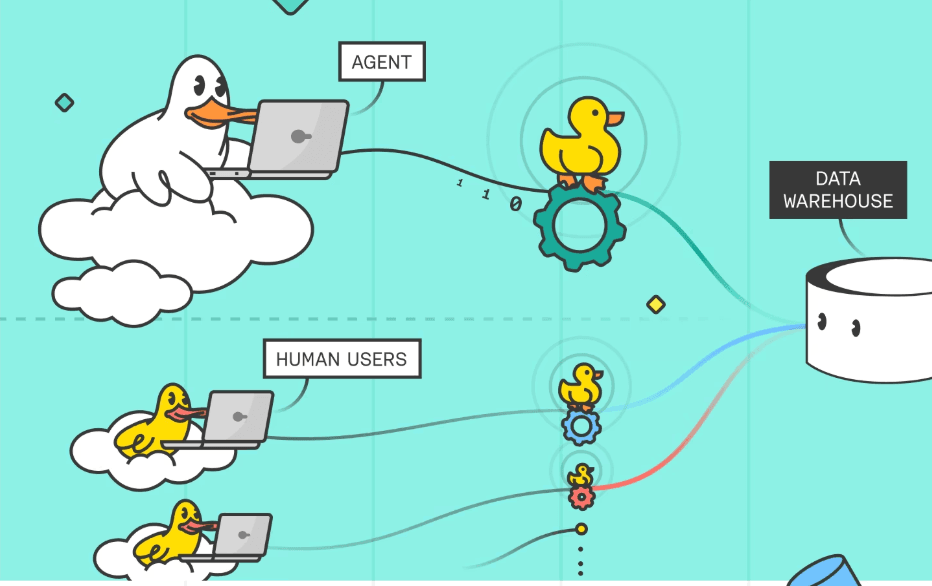
A MotherDuck product diagram. The data warehouse has a face.
I have, at this point, run out of ways to call this whimsical.
None of this is accidental. A duck is small, portable, and inherently absurd, a mascot that rhymes, at the image level, with the thesis that most data is small. The Hadoop elephant, the previous generation’s mascot, was enormous, stationary, and institutional; Cloudera wrapped it in IBM-blue typography. What the elephant was selling, implicitly, was seriousness. MotherDuck’s observation, which is left unstated and fully executed, is that seriousness turned out to be the product whose moment had passed. What they are selling now is relief: the suggestion that your data is probably small, your tooling is probably overbuilt, and the next query you run can, in fact, be a quack away. The whimsy is the wedge.
Consider, next, Bun. The JavaScript runtime created by Jarred Sumner, who in his often-retold origin story had to wait forty-five seconds for a dev server to reload every time he changed a line of code and decided, as any reasonable person would, that this constituted a personal affront. He spent a month reading WebKit’s source code, then built a runtime on top of JavaScriptCore (Safari’s JavaScript engine, not V8) that did in milliseconds what Node did in half-minutes. His company, Oven, raised $7 million from Kleiner Perkins in 2022 and $19 million from Khosla Ventures the following year. Bun’s mascot is a cheerful cream-and-lavender loaf with rosy cheeks. The press kit signs off with “Baked with ♥ in San Francisco.” The release notes are benchmark-dense and tonally unhinged; characteristic titles include “500x faster postMessage(string),” “30x faster than npm,” and the Bun 1.0 launch post, which closed with the Apple-grammar joke “Bun more thing.” Sumner’s personal Twitter, which is more or less co-extensive with the company’s voice, consists of confrontational benchmarks posted in lowercase and the occasional taunt. My favourite, which I have re-read more than is dignified: “I bet ‘npx bun install’ is still faster.” The claim holds even when you invoke Bun through npm itself. Bun wins. A runtime whose founder will trash-talk npm from inside npm is a runtime with a point of view.

Bun (left) and Node (right), as their respective brand teams would like you to hold them in your mind.
One of them has a face. One of them does not. This is, I believe, the entire argument.
And then, on December 2, 2025, Bun was acquired by Anthropic[3].
I want you to hold that last sentence in your mind for a moment, because it is the thing that clarifies the whole trend, and possibly also ends it.
Anthropic’s brand identity was designed by Geist, a London studio, over two and a half years. The typography is Styrene and Tiempos: Commercial Type’s sans and Klim’s serif, respectively, the fonts of serious magazines and museum catalogues. The primary colour is a warm terra-cotta, #da7756, the colour of Sienese masonry in late-afternoon light. Reviewers have called the look “more at home in a think tank than in a tech startup,” which is both the intended reading and, occasionally, the complaint. Anthropic signals trust through the minimal-premium vocabulary, the strain of anti-enterprise branding that rejects Oracle-seriousness through refinement. Linear runs on the same strain. Vercel runs on the same strain. So do Resend, Cursor, Clerk, and much of what someone ought to have named by now: the black-Inter-on-pure-white aesthetic of the current founder class.
The pink loaf has, in other words, been swallowed by the terra-cotta serif. Whether this is a vindication of whimsical branding (the loaf wins so thoroughly it gets an exit) or its quiet institutionalisation is a question I do not yet know how to answer. Jarred has promised Bun will remain open source and MIT-licensed. One notes, cautiously, that this is a thing every acquired founder posts in the first hour of every acquisition ever announced.
Something similar, though at an earlier stage and in an entirely different category, is happening in consumer robotics. Sunday Robotics emerged from stealth in November 2025 with $35 million from Benchmark and Conviction. It is the work of two Stanford roboticists, Tony Zhao and Cheng Chi. Their product, called Memo, is a wheeled household robot with a glossy white body, two articulated arms, a cartoonish face with long button-like eyes, and, I am not making this up, interchangeable colourful baseball caps. Press coverage compares it, inevitably, to Baymax from Big Hero 6. The homepage tagline is “The helpful robotics company,” a sentence that would have been inconceivable at an adversarial humanoid-robotics firm even three years ago. The competitor set (1X, Figure, Physical Intelligence, Kyle Vogt’s The Bot Company) is cast in the opposite register: military-grade black and grey, Silicon-Valley geometric sans, the aesthetics of seriousness reasserting themselves at exactly the moment the robots might do something consequential. A pale robot named Memo in a baseball cap is, in that context, a positioning statement. The robotics industry is, at long last, permitted to be friendly.
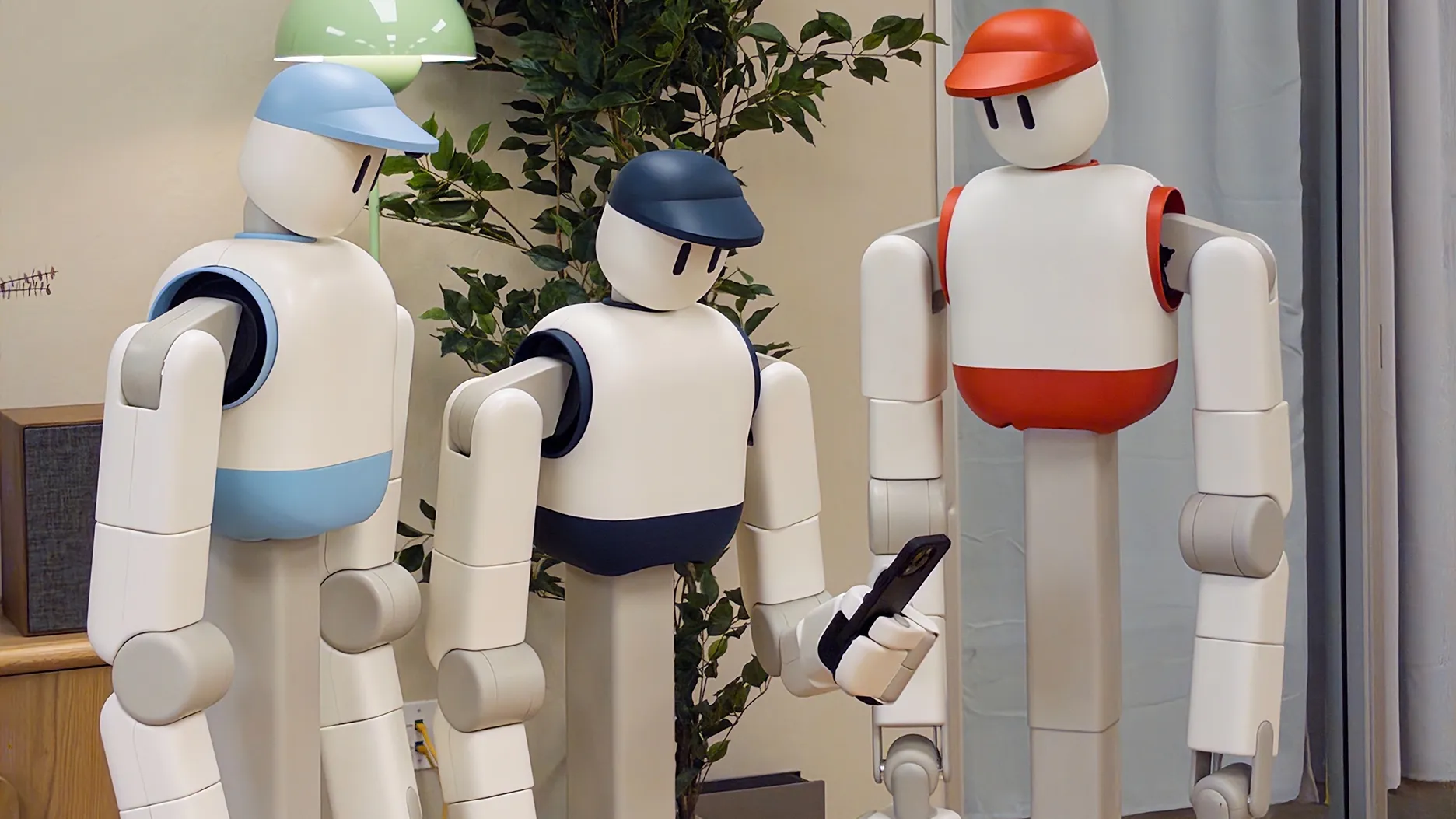
Memo. Built, per the homepage, to be helpful.
The baseball cap, I am reliably told, is optional.
I should admit, before I go further with the argument, that I have been watching this play out rather longer than turbopuffer has existed. Some years ago I worked at Waze, and briefly at Google Maps, during the period when the two products sat under a single corporate roof and steadfastly refused to behave as though they were related. Google Maps was utility, a clinical navigation surface optimised for the part of you that has to file an expense report. Waze was a neighbourhood: the little car with eyes, the chorus of horn-honks when a driver reported a police trap, the “Wazers” who ranked up for contributing edits to their local map. Google acquired Waze in 2013 for $1.1 billion and, crucially, did not fold it into Maps. They kept the two products running in parallel, with distinct aesthetics and distinct communities, because whoever approved that deal understood, a decade earlier than most, that the brand was doing structural work the underlying map data could not. A decade before turbopuffer, Waze had already made the case that logo differentiation was worth nine figures even in a category as unglamorous as “turn left in a quarter mile.” The current wave is simply late. A decade late.
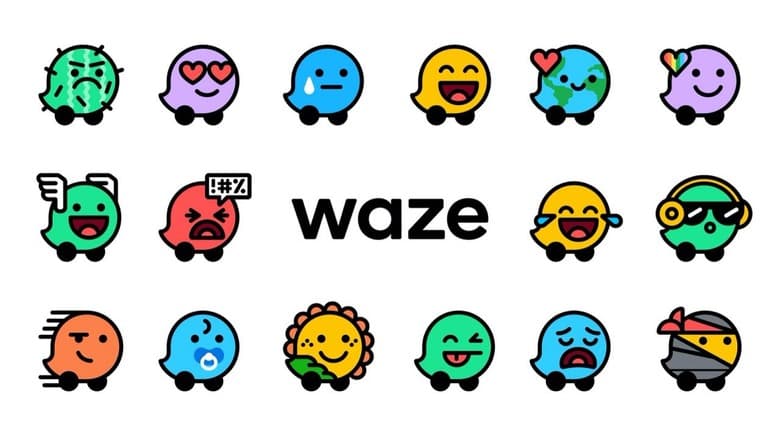
Waze. The mascot, the community, the palette.
Google paid $1.1 billion for this in 2013 and wisely declined to repaint it.
What I find interesting, and what I have not yet seen argued cleanly in any single essay, is that these movements amount to two distinct strains, both reacting to the same parent.
The parent is enterprise-IBM-Oracle seriousness: navy, Helvetica, the unironic use of the word solutions. The two children are the whimsical-mascot strain (Bun’s loaf, MotherDuck’s duck, turbopuffer’s pufferfish, Sunday’s Memo) and the minimal-premium strain (Linear’s dark typographic restraint, Vercel’s black-and-white confidence, Anthropic’s terra-cotta serif, Resend’s letterpress reserve). Both are bids for the same territory, we are not Oracle, though they target slightly different developer self-images. The whimsical strain flatters the engineer who knows she is smarter than her procurement process and enjoys being reminded of it. The minimal-premium strain flatters the engineer who would like to believe she is, at some deep level, a craftsman working on cathedrals. Both strains are, in my observation, doing the same structural work in the same market, through two separate emotional registers[4].
Both strains earn their keep. They are functional answers to an economic question that has become urgent: when the technology itself is commoditising, when any model of reasonable capability can write passable code, when the features of your product can be cloned in a weekend by a competitor with a Claude subscription, what, exactly, is your moat?
The cleanest articulation I have found is from Dylan Field, the founder of Figma, who titled a recent podcast episode “Taste Is Your Moat.” His line, worth reading slowly: “The better cogeneration gets, the more design matters.” Rex Woodbury, in his Digital Native newsletter, has written the same thing under the title “In the Costco Era of Software, Design Is the Differentiator,” with the supporting observation that roughly thirty percent of Microsoft’s code is now AI-generated, meaning the marginal cost of producing another feature is approaching zero. Karri Saarinen, at Linear, has been saying a version of this for years, in a set of ten rules for product craft that include “The best design is opinionated” and a much-quoted remark that quality is not perfection; it is continuous refinement against a known standard. The thesis is consistent across the practitioners and consistent across the analysts: as the marginal cost of building software approaches zero, the residual defensibility of any product is its taste: the coherent voice, the distinctive mascot, the release notes that sound like they were written by an actual human being. The cute duck, in this reading, is the last remaining moat.
I am aware I have just made a large claim, and I would like to acknowledge the most serious counter-argument before I pretend to have an answer of my own.
The sceptic’s case is articulated most cleanly by Packy McCormick in Not Boring: brand is, he has written, “a very weak moat until you have it.” His point is that brand is a lagging form of defensibility; it arrives after you’ve already won on some more structural axis (network effects, data advantages, distribution lock-in) and then provides a cushion against imitation. On this view, Pinecone lost on structure. Its architecture was expensive and its pricing was untenable, and the branding is simply a visible consequence of who was willing to take the architectural bet. Object storage won, and the duck came along for the ride[5].
I find this persuasive up to a point, which is the point where I notice that the founders at turbopuffer, MotherDuck, Bun, and Sunday, four companies doing four unrelated things, in four unrelated product categories, with four unrelated technical bets, all made the same kind of aesthetic choice at approximately the same time. It is difficult to argue that four coordinated aesthetic gestures, across four unrelated technical risks, are epiphenomenal. Something about the current moment is selecting for a particular register, and the register is, in turn, selecting for a particular kind of founder, and for a particular kind of engineer who wants to work for them.
Ben Thompson, in a Stratechery piece from 2016 that has aged beautifully, called this “the consumerisation of IT”, the observation that software purchasing had shifted from the CIO concerned with procurement to the individual engineer concerned with her own experience of the tool. Stewart Butterfield’s earlier and equally durable memo to the Slack team, “We Don’t Sell Saddles Here,” made the same argument in a different register: Slack sells an organisational transformation that happens to feel good, and merely calls it software. The current whimsical-mascot wave, I suspect, is the fourth act of the same play. Slack consumerised the chat client. Figma consumerised the design tool. Linear consumerised the issue tracker. Now turbopuffer and MotherDuck and Bun and, perhaps, Sunday are consumerising infrastructure proper, the category thought to be structurally exempt from consumer aesthetics on the grounds that the buyer was not the user.
What turns out to have been wrong with that last assumption is that, in the AI era, the buyer increasingly is the user. The engineer deploying the vector database is the same engineer writing the code that queries it, and the engineer writes to legal in the afternoon and to Hacker News at night. The aesthetics of trust now have to satisfy both audiences at once. A monospaced pufferfish, it turns out, is a remarkably efficient way to do exactly that.
I do not have a conclusion, on this or on most subjects worth writing about. What I have are observations.
That the companies winning the category fights of the mid-2020s (the databases, the runtimes, the robotics firms, the ones that were supposed to be impossible to dislodge from their incumbents) are, to a notable degree, the ones whose founders treated the brand as a first-order engineering problem.
That brand as moat is a phrase that has been deployed sloppily for decades but that, in the specific context of an AI-commoditising technology stack, finally has the structural pressure behind it to carry real weight.
That the whimsical-mascot strain and the minimal-premium strain are siblings, however little they look alike, and that their convergence on a common parent (anti-Oracle, founder-voiced, engineer-intimate) is visible now in a way it was not three years ago.
And that the moment Bun, the pink loaf, was absorbed into Anthropic, the terra-cotta serif, is either the genre’s coronation or its quiet institutionalisation, depending on whether you believe the acquired company retains its voice. The answer, I suspect, will be clear in about eighteen months, which is the average half-life of founder quirk after any enterprise-software acquisition ever announced.
One notes, with some uneasiness, that the phrases “Long-Term Memory for AI” and “Quacking Around the Web” are separated by only a few years and a great deal of aesthetic distance, and that the distance is, all of a sudden, travelling in the wrong direction.
The crocuses, as ever, do not know about any of this. I increasingly feel they are right.
Required reading for this dispatch:
- Tigani, J., “Big Data Is Dead” (2023)
- Eskildsen, S., turbopuffer: fast search on object storage (2024)
- Sumner, J., “Bun joins Anthropic” (December 2, 2025)
- Field, D., “Taste Is Your Moat”, Latent Space (2025)
- Saarinen, K., “10 Rules for Crafting Products That Stand Out”, Figma (2025)
- Woodbury, R., “In the Costco Era of Software, Design Is the Differentiator”, Digital Native (2025)
- Thompson, B., “Chat and the Consumerization of IT”, Stratechery (2016)
- Butterfield, S., “We Don’t Sell Saddles Here” (2014)
- McCormick, P., “When to Dig a Moat”, Not Boring (2020)
- Mackenzie, A., “turbopuffer”, Why Now (2025)
- The Information, “Top-Funded AI Database Startup Pinecone Considers a Sale” (August 31, 2025)
From the desk of,
— S.L.