
18 July 2026
The Video Assistant Referee
Will See You Now
A dispatch on global football, public trust,
and the particular genius of introducing AI with a disallowed goal and a suggestion box.
Football has acquired a new silence, and on a bad night it lasts long enough for celebration to become waiting. It begins the instant the ball crosses the line, when a stadium rises as one body, and it spreads a beat later, row by row, with the dawning knowledge that the goal is, for the moment, a hypothesis. The scorer slows mid-sprint with the expression of a man who uncorked the champagne before the family solicitor reached the phrase “subject to probate.” Every eye leaves the pitch and finds the screen, where the check is announced. Cut to Dallas, where video officials inspect the system’s finding, informed by connected-ball data and sixteen optical cameras that have been watching the scorer’s shoulder blades more attentively than his own mother ever did. The crowd holds its joy in escrow. The scanned ghost and offside line arrive afterwards, an illustrated receipt for the referee’s decision.
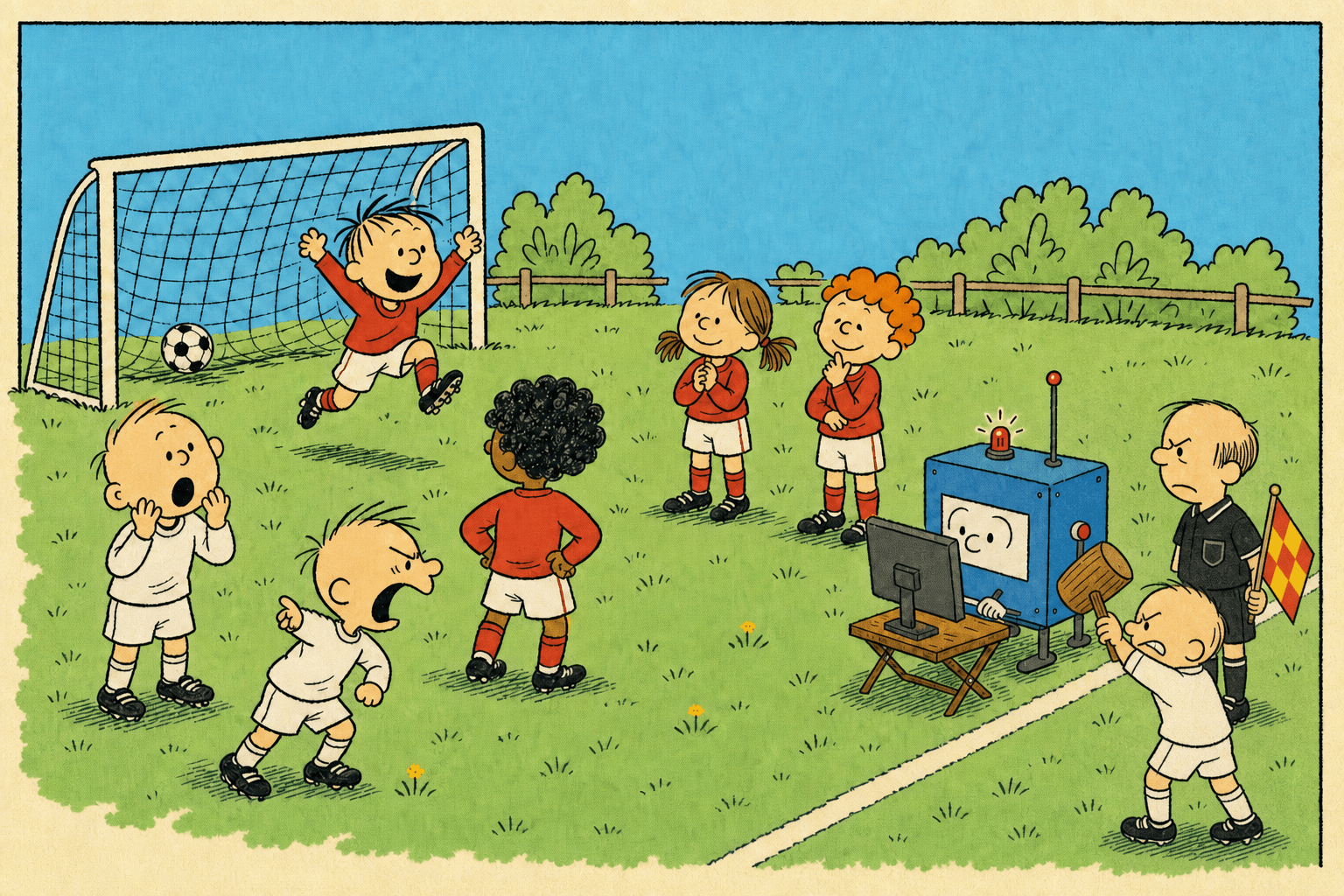
The neighbourhood match enters the administrative phase.
The silence travels through the most efficient distribution system humanity has built for a feeling. FIFA secured broadcast agreements in more than 220 territories for this World Cup, a total exceeding the United Nations’ membership through an administrative mystery best left to Zurich. During the opening week, 192 million unique viewers had already watched in China; 74.4 per cent of Panama’s television audience tuned in; Norway recorded a 97 per cent television share, leaving three per cent of the available television audience to mind the fjords[1]. The game reaches capitals, villages, bars, kitchens and phones. It requires no model account, product training or prior opinion about artificial intelligence. This summer, the technology came included with the football.
Football’s technological education has arrived by World Cup instalment. Goal-line technology reached the tournament in 2014; VAR installed video officials before banks of screens in Moscow in 2018; Qatar’s cameras learnt anatomy in 2022, using tracked limbs, ball data and artificial intelligence to prepare offside calls. This summer’s instalment added sixteen optical cameras per stadium, a sensor inside the ball and 1,248 scanned players. The Laws remain in the care of IFAB, founded in 1886, where the four British home associations retain half the votes under an arrangement of enviable constitutional stamina[2]. A Victorian law book now travels with a signals department. Admission to the demonstration is included with the match.
This was a public demonstration of AI-assisted authority inside an institution already loved. It watched bodies from an unseen room and converted celebration into a claim awaiting approval. The World Cup carried that lesson across more than 220 territories. Anthropic would shortly purchase the commercial break and provide the cemetery.
Under the present regulations, a goal is an application for a goal. The scorer lodges it by putting the ball in the net; the crowd may express provisional delight pending verification of Offside, Handball, Attacking-Phase Offence and Such Further Matters as the Video Assistant Referee May Deem Material; successful applicants receive a kick-off, unsuccessful ones a diagram. Emotion, regrettably, has already been disbursed. There is no form for its return.
The machinery behind the interruption deserves precision. VAR is a human review arrangement: video officials in a room, empowered by protocol to communicate with the referee. The relevant automated stack combines computer vision, player tracking, ball data and artificial intelligence. Sixteen optical cameras in each stadium produce more than 150 million tracking points per match. The Trionda—a handsome four-panelled ball with the résumé of a signals officer—carries a five-hundred-hertz motion sensor. All 1,248 players spent roughly ninety seconds in a scanning rig, allowing broadcast replays to dress tracked skeletons in accurate flesh[3]. Clear positional offside alerts now travel directly into the match officials’ earpieces. Interference and other judgement calls remain with the officials. The “semi” is doing quiet, load-bearing work.
Official responsibility follows a documented chain ending with the referee. Pierluigi Collina emphasised this when the technology launched in Qatar and rejected the nickname “robot offside”[4]. The screen compresses cameras, ball sensor, video room, referee, law, replay and unseen voice into a single public object called VAR. It watches from elsewhere and returns a verdict. Each controversy arrives with an organisational chart. Public sentiment has never observed a service boundary.
By July, the lesson had acquired international case law. At Iran–Egypt, semi-automated offside detected the front of Shoja Khalilzadeh’s boot beyond the line; the resulting decision nullified the stoppage-time goal that had briefly put Iran through. Croatia’s stoppage-time equaliser against Portugal vanished after the connected ball registered a touch attributed to Igor Matanović’s hair, invisible in the available replays. Switzerland’s Breel Embolo received a second yellow after a VAR review reassigned Leandro Paredes’s card to him; he left the pitch in tears[5]. The sequence became familiar in every commentary language: celebrate, wait, watch the screen, lose.
The protocol has responded as mature governing bodies do: it has acquired clauses. Under this year’s measures, a clearly incorrect corner may be corrected immediately, provided the intervention causes no delay; a clearly incorrect second yellow may be reviewed when it produces a red; a card assigned to the wrong gentleman may be lifted from him and conveyed to the correct gentleman, including occasions on which conveyance produces dismissal, subject throughout to the referee’s right to stand before a small screen with one finger at his ear and the expression of a peer discovering death duties. Embolo’s case was clerically immaculate. To the audience, this was automated jurisdiction expanding one clause at a time, with no restart for tears.
The feelings were already measurable. In March the Football Supporters’ Association polled nearly eight thousand English supporters: 75.7 per cent opposed VAR, 91.7 per cent said it had removed the spontaneous joy of goal celebrations, 86 per cent expressed concern about expanding its remit, and 3.3 per cent thought it had improved the match-going experience[6]. The FSA had managed to assign a decimal place to grief. IFAB’s 2026 measures extended review to corners, giving the decimal place somewhere official to go.
The injury is temporal. A goal detonates in the body before thought arrives: arms rise, strangers collide, beer travels in a glittering arc, somebody begins a sprint towards the corner flag with no plan for the return journey. Review turns every one of those acts into an unsecured loan. By the time the screen restores a scoreline, the first roar has passed into something more cautious. The crowd learns to wait.
Joy, once reviewed, is never returned in its original condition.
This lesson travelled into a public carrying uneven knowledge and considerable nerves. In a Pew survey across 25 countries, a median 14 per cent had heard nothing about AI and 47 per cent had heard a little; awareness rose with national income, education and internet use, and was generally higher among younger adults. Twelve per cent of adults in Kenya and fourteen per cent in India said they had heard a lot. In no surveyed country did a majority select “more excited than concerned” about AI’s increased use in daily life. A separate thirty-country Ipsos study found that, on average, 53 per cent were nervous about products and services that use AI[7]. The World Cup entered more than 220 territories carrying the same demonstration: an AI-assisted system watches, an unseen office rules, the human moment becomes provisional.
Public enthusiasm, under the industry’s present arrangements, may be expressed during Standard Innovation Hours, subject to suspension whenever a Safety Announcement, Job-Displacement Forecast, Surveillance Hearing or Congressional Inquiry activates Extended Concern Procedures, after which optimism may resume upon certification by the Public Trust Committee that the Public Trust Committee remains properly constituted. Football required no committee. It put the system on television. For viewers already suspicious of AI, the tournament supplied a goal, a green line and a grievance onto which that suspicion could fasten. Sensor fusion entered the public story as unseen authority with power over joy.
Here the pronoun becomes inconvenient: we. I work in this industry; its public story is our work. Our industry already knew how to make a human advertisement. In February, Anthropic’s own Super Bowl spots staged manipulative chatbots as overeager people and made the joke land; Google’s gentle New Home placed Gemini beside a mother and son imagining their house. Google, an institution rarely accused of underestimating the acreage of an advertising opportunity, carried the same instinct into the World Cup. Its World Cup work used AI Mode to explain formations and Gemini image templates to place supporters in their national colours[8]. The technology came dressed for football. It explained the game and indulged a little vanity. It sounded pleased to be invited. We should have done better.
Anthropic entered the World Cup’s public story of AI-assisted authority in the American commercial break and supplied the glacé cherry. The company had measured the public mood in advance. Its nationally representative online survey of 51,993 Americans aged sixteen and over, including AI non-users, found that 64 per cent were worried AI would displace jobs and 15 per cent said they trusted AI companies to make decisions about how the technology should be developed and used[9]. Those figures described an audience carrying substantial fear and little reported trust. Anthropic commissioned the research and published the numbers. This was the company’s own guest list.
On 9 July, Anthropic launched “Inviting hard questions”: a public site, a pledge to answer and a ninety-second film created by Mother London, published under Claude’s name and Anthropic’s authorship. A sharp piano note sounds. A house burns at night. Facial-recognition boxes settle over a crowd. A person sleeps on the street. Rows of cemetery headstones fill the frame as a voice asks, “Who’s going to hit the brakes if we need to?” Teachers and mothers arrive later; the closing card reads, “There’s hope in the hard questions. Keep thinking.” The film proceeds with the grave decorum of a country-house memorial service whose deceased remains unidentified. The company had bought a World Cup audience and selected the mourning stationery.
The film aired on Fox during the Argentina–Switzerland quarter-final, whose US English-language telecast averaged nearly sixteen million viewers. The match contained Embolo’s VAR-assisted dismissal. The football and the advert now occupied one emotional sequence: retrospective review, a reassigned card, a burning house, biometric surveillance, cemetery graves and a question about the brakes. This is a dossier with a media buy. The audience performed its own review immediately. Viewers called the film “unbearable,” “straight dystopian” and “the worst commercial I have ever seen.” Another said it “made me want to gag”[10]. A campaign inviting hard questions received the most immediate one: who approved it?
I found the advert dystopian, dark and astonishingly careless with the public impression it offered during the tournament. A company building advanced AI had purchased rare mass-audience airtime and used the occasion to stage catastrophe. It is the communications equivalent of a surgeon entering a nervous patient’s waiting room, dimming the lights, placing a funeral programme on every chair and announcing a listening exercise. The patient will remember the funeral programme.
Anthropic arranged fire, surveillance and graves beneath the banner of hope. It attached a suggestion box. The film offered advanced AI through a simple account: it watches, threatens and asks to be trusted. Brands spend fortunes to own a word. This campaign bought dread.
By 15 July, immediate online criticism filled the public record. The World Cup put AI-assisted authority before a global mass audience in an emotionally charged setting; its repeated verbs were watch, review and cancel. Anthropic added catastrophe. One of the industry’s leading laboratories had art-directed dread for the commercial break.
We build the machinery and its first impression. Both are our work. The introduction should show what technology can help people understand, make and enjoy; it should explain the machinery and its limits with some evidence of life. The future will acquire its meaning through a thousand ordinary encounters. A World Cup is one of them. Its joy should remain spendable on arrival.
On Wednesday, Argentina trailed England until the eighty-fifth minute. Enzo Fernández equalised; two minutes into stoppage time, Lautaro Martínez headed Argentina into the final. Tens of thousands poured into the streets of Buenos Aires. One supporter climbed a traffic light. Others sprinted shirtless through the winter rain. Celebration commenced under Emergency Semi-Final Joy Provisions, Standard Semi-Final Joy Hours having proved unequal to the occasion. No committee appears to have been consulted.
That is the job now: build the future, explain it properly and leave people enough unreviewed joy to climb a traffic light in the rain.
From the desk of,
— S.L.
Required reading for this dispatch:
- FIFA, “World Cup 2026 broadcast partnerships set new global benchmark” (11 June 2026)
- FIFA, “World Cup 2026 captivates global audiences” (22 June 2026)
- FIFA, “The hidden technologies at the 2018 FIFA World Cup” (3 June 2018)
- FIFA, “VAR at the 2018 FIFA World Cup” (2018)
- FIFA, “Semi-automated offside technology to be used at FIFA World Cup 2022” (1 July 2022)
- IFAB, “Background” (accessed 16 July 2026)
- IFAB, “Organisation” (accessed 16 July 2026)
- FIFA, “Faster offside decisions, more stable referee body cams” (3 June 2026)
- FIFA, “FIFA World Cup 2026 International Broadcast Centre opens in Dallas” (2 June 2026)
- FIFA, “3D player scanning” (2026)
- Adidas, “Adidas unveils Trionda” (3 October 2025)
- FOX Sports, “Why Iran’s Late Goal Against Egypt Was Ruled Out For Offside” (27 June 2026)
- IFAB, “Further measures to improve match flow and player behaviour” (28 February 2026)
- Sporting News, “Croatia offside call, explained” (3 July 2026)
- ESPN, “Switzerland’s Breel Embolo receives red card for diving” (12 July 2026)
- Football Supporters’ Association, VAR survey (30 March 2026)
- Pew Research Center, “How People Around the World View AI” (15 October 2025)
- Ipsos, “Conflicting Global Perceptions around AI” (5 June 2025)
- O’Brien, M., “Anthropic, OpenAI rivalry spills into new Super Bowl ads”, Associated Press (5 February 2026)
- Google, “Watch our new Gemini ad ahead of football’s biggest weekend” (5 February 2026)
- Google, “4 ways soccer fans can catch every moment of the tournament” (8 June 2026)
- Bradley, S., “Google’s World Cup brand counterattack highlights shifting search behavior”, Digiday (25 June 2026)
- Anthropic, “Results from the first Anthropic Public Record” (12 June 2026)
- Anthropic, “Inviting hard questions” (9 July 2026)
- Kurup, S., “World Cup fans slam ‘unbearable’ Claude ad”, AOL (12 July 2026)
- Beer, J., “Advertising isn’t the answer to Anthropic’s hard questions”, Fast Company (14 July 2026)
- FOX Sports, “FOX Sports scores top two most-watched World Cup quarterfinal telecasts” (13 July 2026)
- Robson, J., “Defending champion Argentina reaches World Cup final by beating England 2–1”, Associated Press (15 July 2026)
- Debre, I., “Tens of thousands of Argentine soccer fans celebrate their team’s World Cup semifinal victory”, Associated Press (15 July 2026)