INTENT IS BROKEN
A map of fashion commerce after the search bar

we don't need more clothes

For the better part of a decade, commerce has optimised its machinery: frictionless checkout, algorithmic agents and endless scroll. A shopper's intent now passes through retailers, closet apps, feeds, marketplaces and affiliate links, each tuned for conversion. The system's default reply is another product.

need impulse context checkout I am shopping for a new wardrobe for a body, budget, closet, occasion and climate RETAILERS MARKETPLACES CARTS AI FINDERS
Scroll

Fashion commerce needs a stronger sense of restraint.

Fashion commerce has spent more than a decade optimising discovery, feeds, affiliate links, search, resale liquidity, live shows, chatbots and checkout. The hard question has barely changed: should this person buy this thing at all?

That is why the space feels so fragmented. Every layer owns a piece of the user's intent, and most layers are paid to convert that piece inside their own inventory.

The backdrop

The system keeps making more.

Before we map the startups, the retailers and the carts, look at the shape of the problem. Material production keeps breaking records. Recycling barely touches the new supply. Returns and abandoned carts stayed high.

Each tiny shirt below is one unit of demand the industry tries to convert. The red marks are places where confidence breaks.

more inventory, less certainty 132M tonnes produced 2024 output; 169M projected. 7.6% recycled fibres Less than 1% from old textiles. 19.3% online returns Conversion can mask a wrong purchase. 70% abandoned carts A full cart can mark unsettled intent.
How we got here

Shopping remains a database filter.

The current luxury retail drawer asks for category, designer, colour, size, price and sort. Catalogs, feeds, links, cameras and agents keep returning to the same core interaction: narrow this product table.

1992: Filters become database controls

Dynamic query interfaces use sliders, buttons and immediate feedback so people can explore a database through direct manipulation. That is the ancestor of the retail filter drawer.

Entrants: dynamic queries / FilmFinder / database sliders

1995: The catalog moves online

Amazon and eBay make inventory searchable and browsable on the web. The breakthrough is a product database behind links, categories and search results.

Entrants: Amazon / eBay / web catalogs

2000: Fashion adopts the grid

Net-a-Porter helps luxury fashion become a browsable product grid. Amazon Marketplace expands supply. The interface settles into category page, product card, detail page.

Entrants: Net-a-Porter / Amazon Marketplace / luxury ecommerce

2001: Guided navigation turns filters into product UX

Endeca-style guided navigation commercializes faceted search for retail: every attribute becomes a next question the shopper can ask the catalog.

Entrants: Endeca / guided navigation / faceted search

2000s: Facets become the ecommerce default

Size, color, brand, price, category and availability become the standard way to make a large catalog feel navigable. The shopper is mostly operating a multi-dimensional query.

Entrants: retailer sidebars / commerce search / sort menus

2015: The filter drawer stays brittle

UX research finds filtering central to ecommerce. Many large retailers miss category-specific filters or implement poor filtering logic. The primitive remains essential and brittle.

Signals: Baymard / NN/g / ecommerce UX audits

2016: The feed becomes a catalog entry point

Instagram product tags make images shoppable. The tag resolves into product information and inventory. Social discovery becomes another door into the database.

Entrants: Instagram Shopping / Pinterest / affiliate links

2019: Personalization becomes taste targeting

Instagram monetized taste signals through ads, creator affinity and repeated engagement. That machinery understood attention before intention. Most personalisation optimised the next click and left the whole decision untouched.

Anecdote from Screenshop: in 2019, a practical version of personal style meant constraining retrieval around fixed taste anchors: a shortlist of celebrities, creators or stylists. Technically, the query image could become a visual embedding, retrieve nearby products, then use a celebrity or stylist anchor as a style vector for query expansion and re-ranking. In effect: "how would Brad Pitt's stylist style this item?" Search felt more personal. The model lacked the user's closet, budget, body, occasion and permission to recommend restraint.

Signals: creator affinity / celebrity style anchors / visual retrieval / ad personalisation

2023: Content becomes the storefront

TikTok Shop puts shoppable videos, live streams, affiliate links and a marketplace in one app. Entertainment manufactures intent, then routes it into product listings.

Entrants: TikTok Shop / Whatnot / live shopping / creator storefronts

2024: Links and RAG wrap the product table

Creator commerce turns taste into a world of links: ShopMy storefronts, LTK posts, Substack newsletters and affiliate embeds. Retailers bolt AI onto existing catalogs through Rufus and Sidekick. The new front end keeps ending in links, filters, product cards and checkout.

2025: AI fashion finders enter

Phia, Daydream, Beni, Encore and ChatGPT Shopping make the query portable across retailers. They ask better questions and compare more supply. Most resolve intent as a better product list.

2026: Agents pitch commerce infrastructure

Google Universal Cart, Universal Commerce Protocol, ChatGPT product feeds and agentic checkout are early infrastructure bets that move the query above the retailer. This remains an early market forecast. The category stays open: the next front end may be a feed, a newsletter, a camera, a chat box or an agent. Intent stays unsettled when the system only accelerates buying.

Entrants: Google Universal Cart / UCP / ChatGPT product discovery / ACP / agentic checkout
Current landscape of shopping

The splintered supply chain.

After two decades of filters, the answer became a labyrinth of retailers, marketplaces, creator links, visual search, closet apps and carts. Each layer is large enough to matter. Each layer sees one slice of intent.

ζ / Carts + agents

Checkout compresses the end.

1 click from uncertainty to shipment early infrastructure bet

Universal cart creates leverage after intent is resolved. Premature checkout turns uncertainty into shipment.

The missing infrastructure

The catalog is the bottleneck.

The hardest part of search is not the search box. It is turning retailer titles, product photos, variants, resale listings, creator language and shopper slang into the same machine-readable product world.

Pieces exist: Google's Shopping Graph, Amazon's product knowledge graph, Shopify's taxonomy. They are merchant-owned, platform-owned, or optimised for ads. The harder blocker is incentives: a neutral graph would route across retailers, resale, repair, waiting and not buying, which conflicts with everyone's revenue. The missing layer is business-model shaped as much as data-model shaped.

Raw fragments

Merchant titles, colour conflicts, size variants, duplicate listings on resale.

A neutral graph

Entities, attributes and relationships: entity resolution, fit risk, resale match, closet memory.

Better answers

The same item across supply, a similar silhouette, or a better no: repair, wait, skip.

Named entity recognition is table stakes. The hard part is relation quality: taxonomy + visual similarity + shopper language + closet graph + market graph, owned by no one who is paid only when another item sells.

The AI commerce layer

Buying has a new choreography.

The newest interfaces move beyond the product grid: agentic checkout, merchant feeds, brand chatbots, AI boutiques. Most of them make the old system more fluent and preserve its permission structure.

A theatrical oil-painted ballet studio scene where elongated dancers move toward wrapped parcels while one dancer pauses in hesitation.

ChatGPT can move intent to payment.

ChatGPT shopping, Stripe-powered Instant Checkout and the Agentic Commerce Protocol show an early version of agents compressing discovery, payment and merchant handoff into one conversational surface.

This may become infrastructure progress. When the agent's commercial job is routing a user into merchant checkout, the governing question becomes permission: can the agent recommend restraint?

A beautiful brand chatbot lives inside the brand.

Brunello Cucinelli's AI boutique is more thoughtful than a generic FAQ bot. Its public materials describe a pageless, modular, intent-driven experience.

An assistant inside one commercial boundary serves one inventory. Reliable restraint requires comparison across secondhand supply, repair, owned clothing and the user's real budget.

What would actually be new?

I have been thinking about what shopping becomes in an AI-driven commerce economy.

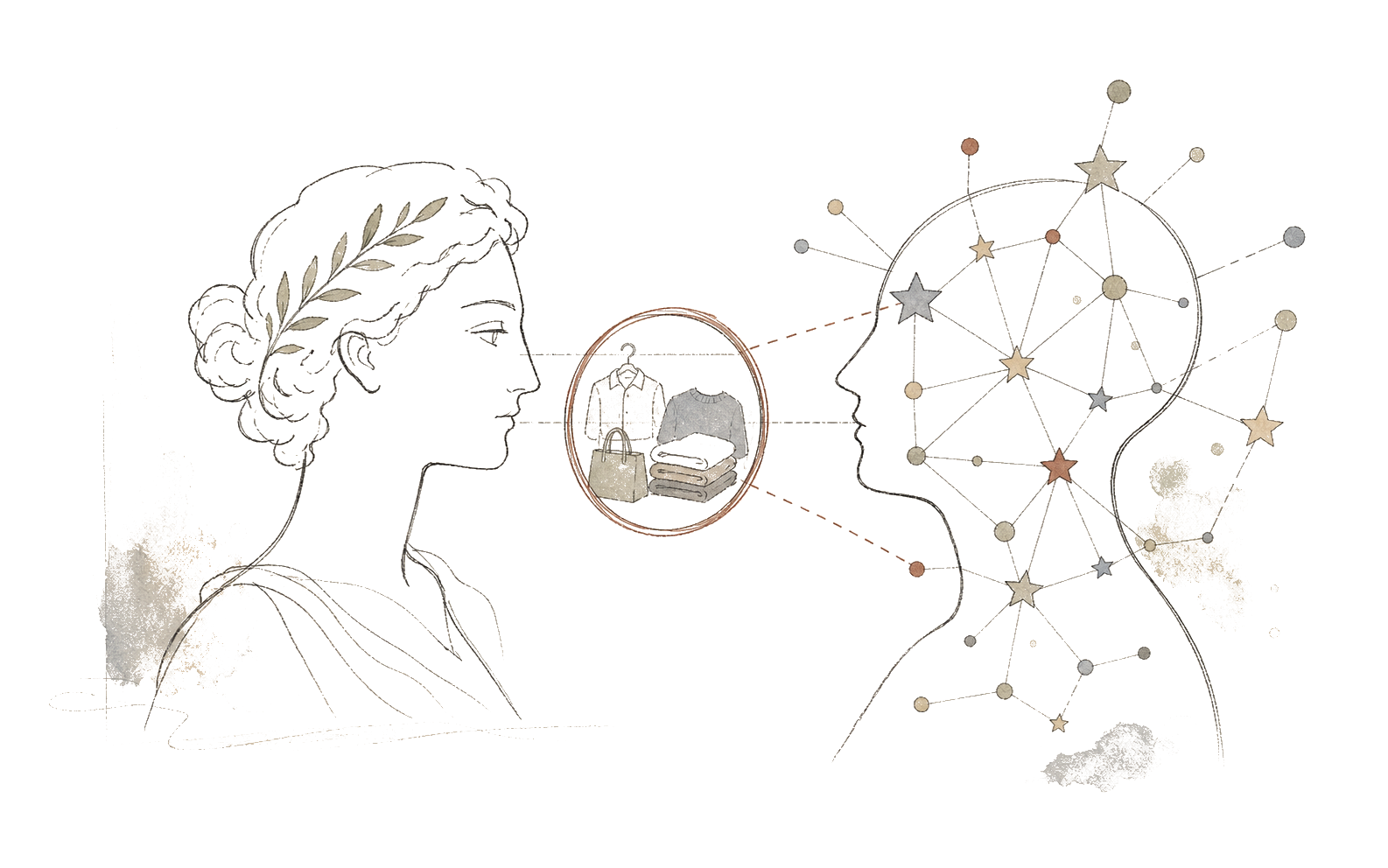
The shift reaches into the structure of the decision itself. Commerce can create a real cognitive loop between a person, their closet, their intent, their taste, their trusted tastemakers, and the supply market around them.

That changes what intent means. A shopper enters commerce with a situation to solve: a trip, a dinner, a workweek, a body change, a budget constraint, a closet gap, an identity shift, or the quiet feeling that her clothes no longer match her life.

The new layer starts with memory. The system should understand what she already owns, what she wears, what she ignores, what she returns, what fits, what duplicates keep appearing, and which pieces already solve the problem. The closet becomes the foundation for reasoning.

Then comes ad personalisation. Real ad personalisation is shopper-owned. It is the user's taste model: her preferred silhouettes, colors, materials, price points, brands, fit history, recurring occasions, saved creators, and trusted tastemakers. Two people can follow the same creator and receive completely different recommendations.

This is where tastemakers become infrastructure. ShopMy, Substack, Instagram, product links, outfit photos, captions, and affiliate storefronts are all taste traces. The opportunity is to turn those traces into a live signal layer: what is gaining heat, what is cooling, what has product proof, what styling formulas are emerging, and which recommendations have receipts.

Agentic commerce becomes powerful when agents can use that memory and improve from it. The agent should know the user's closet, intent, taste anchors, budget, and supply options across sessions. It should be evaluated on decision quality: whether it avoided duplicates, respected the occasion, routed to the right source, explained the tastemaker signal, reduced returns, and made the wardrobe better over time.

This creates a learning loop. Every search, save, skip, return, wear, repair, and purchase teaches the system something about the user. Every tastemaker signal gives the system a stronger read on the outside world. Every agentic decision becomes training signal for the next one.

The output is a commerce interface with judgment. It can say: buy this new, find this resale, rent this, style what you already own, wait two weeks, repair the piece you forgot, borrow it, or skip it entirely.

That is the real unlock. The future of shopping is a memory system, a taste model, a tastemaker signal graph, and an agent that can decide when buying is actually the right answer.
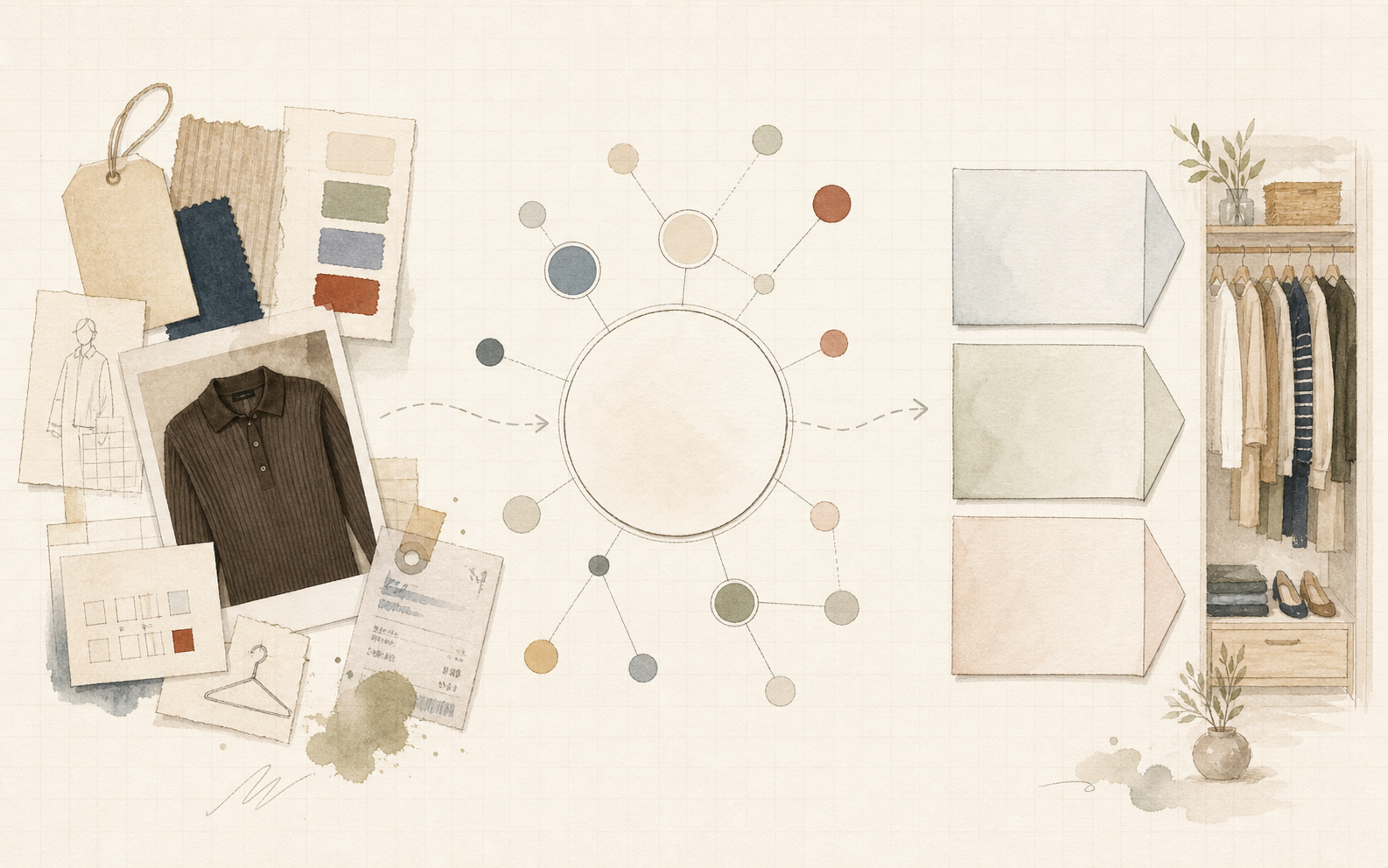

The next shopping interface should know when buying is the wrong answer.

That is the point of the whole system: a commerce layer with memory, taste, supply awareness, and judgment. One that can understand the user, learn from tastemakers, search the market, and protect the integrity of the decision.